

Anton Bruckner
Biography, works and influence.
Anton Bruckner (1824–96) was an Austrian composer, organist and teacher whose monumental symphonies came to be known as ‘cathedrals of sound’. Although a late bloomer as a composer, he became one of the defining symphonists of the late Romantic era, admired for music of immense spiritual depth, structural ambition and emotional intensity.
Who was Bruckner?
Early Life
Born in Ansfelden, Austria, Bruckner studied violin and organ from a young age with his father, the village schoolmaster. After his father’s death in 1837, he became a chorister at the monastery-school of St Florian. His family’s poverty made a musical career impossible; instead, he trained as a school teacher. Following positions in Windhaag and Kronstorf, he returned to St Florian, where he taught from 1845 and was organist from 1848. In 1855, Bruckner became organist at Linz Cathedral, and embarked on a five-year course in harmony and counterpoint with the Viennese pedagogue Simon Sechter. Later, he studied orchestration with Otto Kitzler, who in 1863 introduced him to Wagner’s music. This proved an enormous creative inspiration and led to his first significant compositions.
Finding Success
Moving to Vienna in 1868, Bruckner took up Sechter’s old post at the Conservatory. From 1875, he also taught at the University of Vienna. During the next 28 years he composed most of his greatest works, though for years he struggled to get his orchestral music performed, particularly after the disastrous 1877 premiere of the Third Symphony. Only after the 1884 premiere of the Seventh Symphony in Leipzig did he receive widespread acclaim.
Final Years
Bruckner continued to compose – and revise his works obsessively – during the final years of his life, focusing particularly on his Ninth Symphony, which remained unfinished at his death. Despite growing recognition, he remained personally humble and deeply religious throughout his life. He died from heart failure on 11 October 1896 in Vienna and was buried in the crypt of St Florian Monastery, beneath the organ he had once played.
Anton Bruckner
Born: 4 September 1824, Ansfelden, Austria
Died: October 11 1896, Vienna, Austria
Contemporaries: Richard Wagner, Johannes Brahms, Gustav Mahler, Hans Richter
Best known for: Symphonies Nos 4, 7, 8 and 9; Te Deum
The one piece you have to hear: Symphony No 9
Connection to the LSO: London premiere of Symphony No 8, with Otto Klemperer conducting
Watch
Bruckner’s music performed by the London Symphony Orchestra at the Barbican.
Who inspired Bruckner?
Giovanni Pierluigi da Palestrina, J S Bach and the composers of the First Viennese School were among Bruckner’s heroes. Of his contemporaries, it was Richard Wagner whom he admired most. Bruckner dedicated his Third Symphony to Wagner after the pair spent a convivial evening together, and Wagner considered Bruckner the greatest symphonist since Beethoven.
In Vienna, musical loyalties were divided between Wagner and Johannes Brahms, and Bruckner’s support for Wagner made him enemies. Chief among them was the influential critic Eduard Hanslick, who repeatedly attacked Bruckner’s symphonies. Brahms himself referred to the works as ‘symphonic boa-constrictors’, though he admired Bruckner’s work ethic and sacred music, and was reportedly seen weeping at his funeral.
Bruckner’s own influence was profound, particularly on later Austro-German composers including Gustav Mahler, whose symphonies inherited something of Bruckner’s monumental scale and spiritual intensity.
What are Bruckner’s most famous pieces?
The Symphonies
Bruckner’s best-known works are his Symphonies Nos 3 to 9. Although each has a distinctive character, they share common features: thematic material structured in huge blocks, long passages of intensification (Steigerung), adventurous chromatic harmony and the use of fugues, chorales and Austrian dance rhythms. Other than the unfinished Ninth Symphony, they typically comprise an extensive opening movement exploring contrasting themes, a lyrical slow movement, an energetic folk-like Scherzo and a large-scale finale that often recalls earlier music. Their massive structures have led them to be nicknamed ‘cathedrals of sound’. Bruckner’s structural, harmonic and rhythmic invention makes each mature composition an epic musical journey. His music also possesses an emotional honesty and spiritual depth that continue to evoke a profound response in listeners.
Sacred Music
Alongside the symphonies, Bruckner composed significant sacred works including the Te Deum, three major masses and numerous motets. Deeply religious throughout his life, he brought a sense of grandeur and devotion to his choral writing, combining Renaissance-inspired counterpoint with Romantic orchestral richness.
With the LSO
Although Bruckner’s music was not widely performed in Britain during the early 20th century, the LSO played an important role in introducing his symphonies to London audiences. In 1929, the Orchestra gave the first London performance of Bruckner’s Symphony No 8 under Otto Klemperer. The concert was also historically significant as the first in a new era after the abolition of the Orchestra’s ‘deputy’ system.
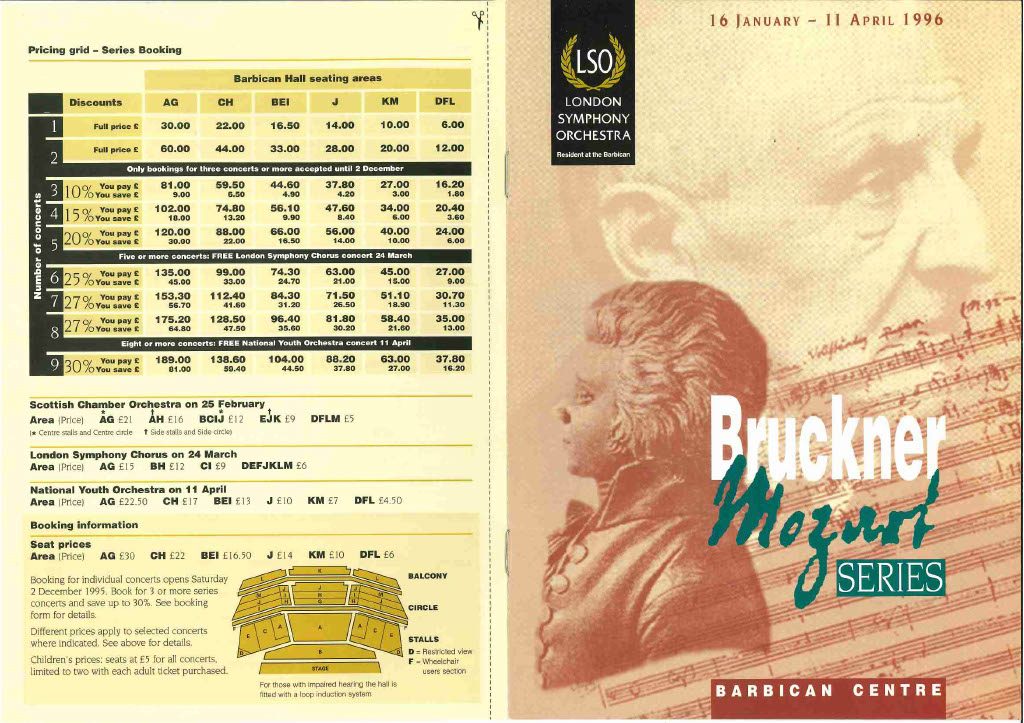
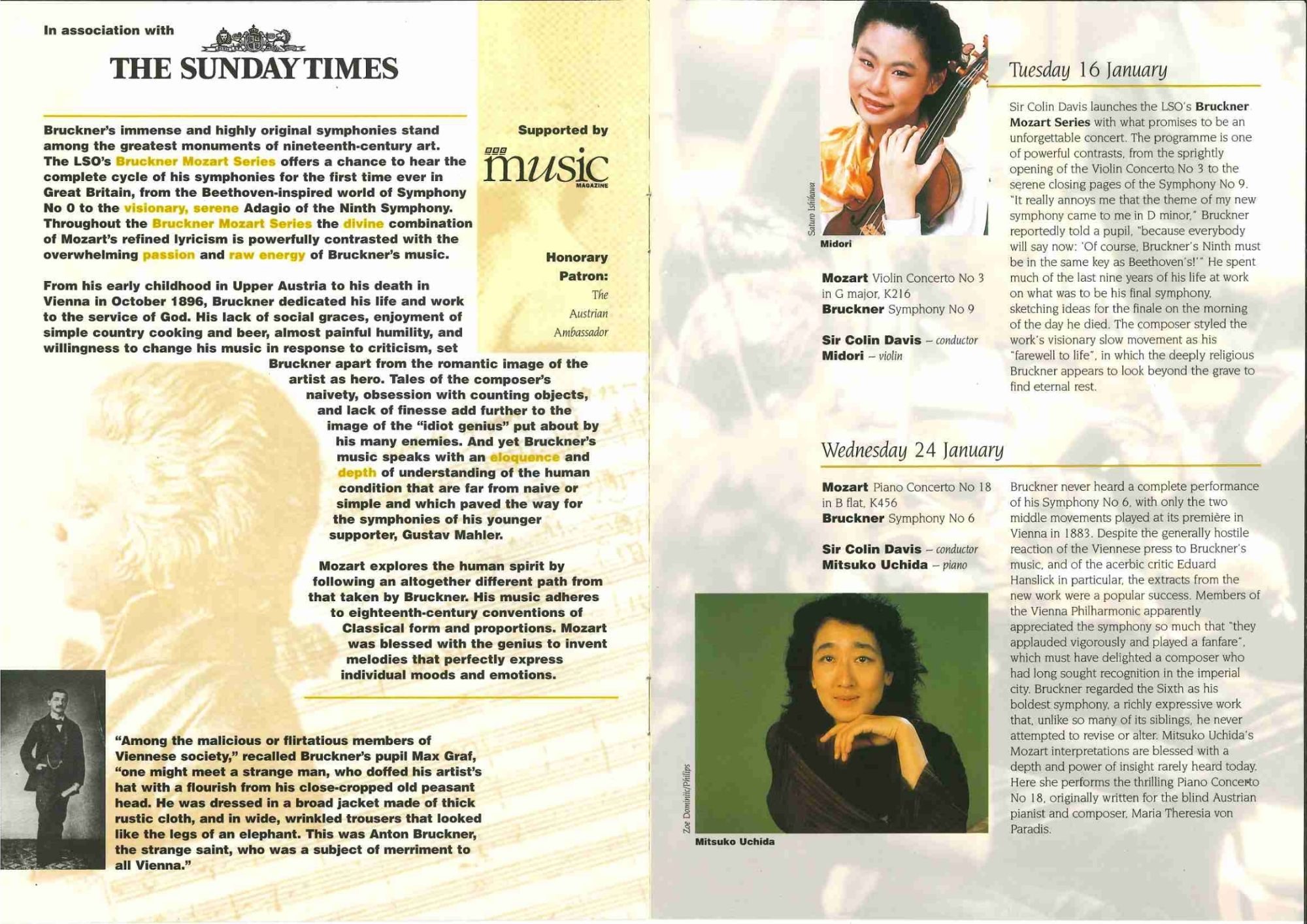
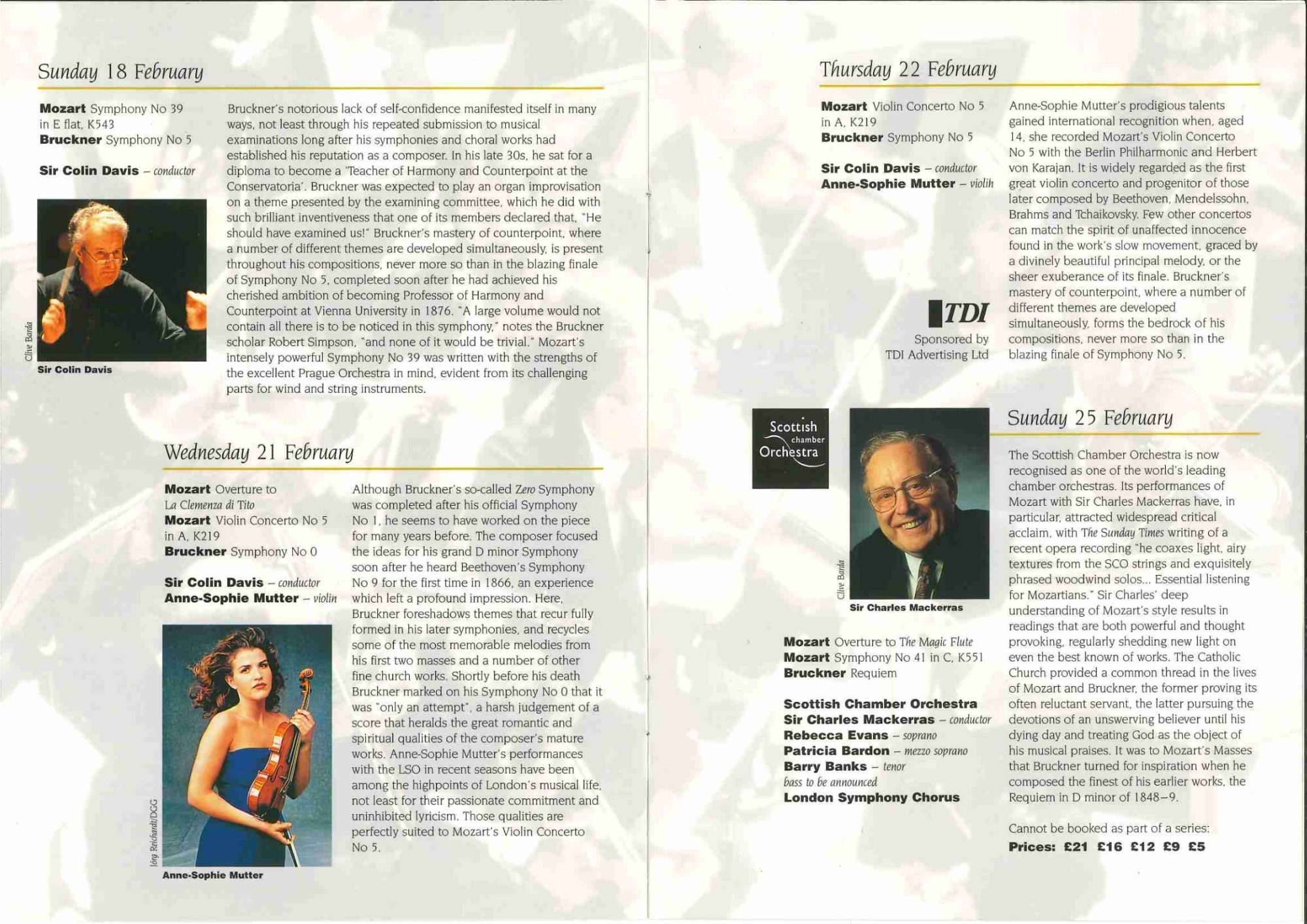
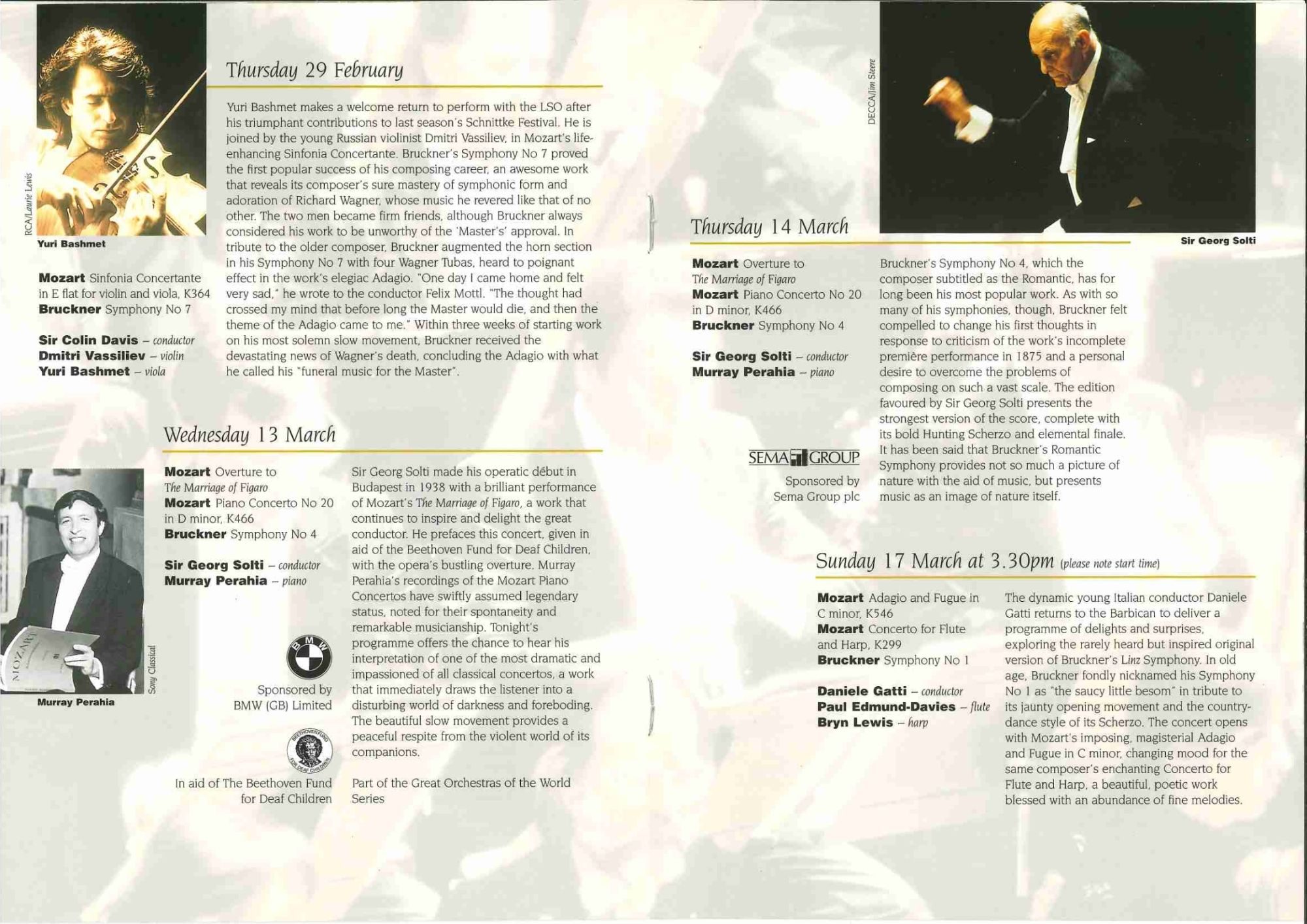
In the 1950s, conductors including Jascha Horenstein and the LSO’s Principal Conductor Josef Krips helped bring Bruckner’s music to greater prominence. Interest in his works continued to grow across subsequent decades, culminating in the highly successful LSO Bruckner Mozart Series festival in 1996. More recently, the LSO gave the world premiere of Benjamin-Gunnar Cohrs’ new edition of Bruckner’s Symphony No 4 at the Barbican on 19 September 2021, conducted by Sir Simon Rattle.
Composer connections
Bruckner’s music is often discussed alongside that of Wagner and Mahler, bridging the worlds of German Romantic opera and the expansive symphonic tradition of the early 20th century. While Wagner transformed opera through harmonic innovation and dramatic scale, Bruckner applied similarly monumental thinking to the symphony. His music has also continued to resonate beyond the concert hall. Films including Luchino Visconti’s Senso and Ingmar Bergman’s Saraband use Bruckner’s music to powerful emotional effect, while writers including Gabriel García Márquez and Douglas Kennedy have referenced his works in fiction.
Listen to Bruckner live
Upcoming concerts featuring music by Bruckner.

Half Six Fix: Bruckner 9
Sir Antonio Pappano
Wednesday 21 October 2026 • 6.30pm
Kick-start your evening with this 60-minute Half Six Fix concert. Sir Antonio Pappano introduces and conducts Bruckner's Ninth Symphony, a piece that contrasts epic walls of sound with moments of aching fragility.
Limited Tickets

Edmund Finnis and Bruckner
Sir Antonio Pappano and Sheku Kanneh-Mason
Sunday 25 October 2026 • 7pm
The quiet intensity of Edmund Finnis’ Cello Concerto, featuring soloist Sheku Kanneh-Mason, paves the way for Bruckner’s monumental, visionary Ninth Symphony.
Limited Tickets

Mozart and Bruckner
Nathalie Stutzmann and Janine Jansen
Thursday 20 May 2027 • 7pm
Violinist Janine Jansen revels in Mozart’s ‘Turkish’ Violin Concerto, before conductor Nathalie Stutzmann reveals the sublime joy in Bruckner’s epic Fifth.
Written by Kate Hopkins
